

Why Tulsa Springs Demand a Real Storm Plan
Spring in Tulsa is beautiful — and electrically punishing. Eastern Oklahoma sits in one of the most active severe-weather corridors in the country, and April, May, and June together make up the bulk of severe storm season. The National Weather Service Tulsa office issues hundreds of severe thunderstorm warnings, tornado watches, and flash flood warnings every spring.
A few numbers worth knowing:
- May is the peak tornado month statewide, with Oklahoma averaging roughly 24 tornadoes in May alone — more than any other month.
- May is also Tulsa's wettest month, averaging just under six inches of rainfall.
- April 2025 was Tulsa's wettest April on record, with nearly 11 inches of rain.
- The April 27–28, 2024 outbreak produced 8 tornadoes inside the NWS Tulsa forecast area; the May 6–7, 2024 event added another 5.
For a Tulsa homeowner, that translates to a recurring set of electrical risks every spring: lightning surges, wind-blown branches taking down service drops, hail bruising AC condensers, water in the panel from blown-in rain, and outages that can last anywhere from a flicker to several days.
This checklist is built around three simple windows of time: before, during, and after a Tulsa storm. Walk through each one and you'll be ahead of 90% of your neighbors when severe weather hits.
Before the Storm: Your Pre-Storm Electrical Checklist
The work you do *before* a thunderstorm is the highest-leverage electrical work you'll do all spring. None of it is glamorous; all of it pays off.
1) Schedule a Pre-Storm Electrical Inspection
A licensed Tulsa electrician can spot the problems homeowners miss: corroded service equipment, loose neutrals, panels that are warm to the touch, undersized breakers, missing bonding, and aging surge protection. We bundle this kind of pre-season check into our standard Electrical Repair service.
A 60- to 90-minute inspection in March or April typically includes:
- Thermal imaging of the panel under load
- A visual inspection of the service entrance (mast, weatherhead, meter, conduit)
- Verification that grounding electrodes and bonding are intact
- Testing of every GFCI and AFCI breaker
- A surge protection assessment
If you're scheduling one storm-prep call this season, this is it. Contact us to book.
2) Install Whole-Home Surge Protection
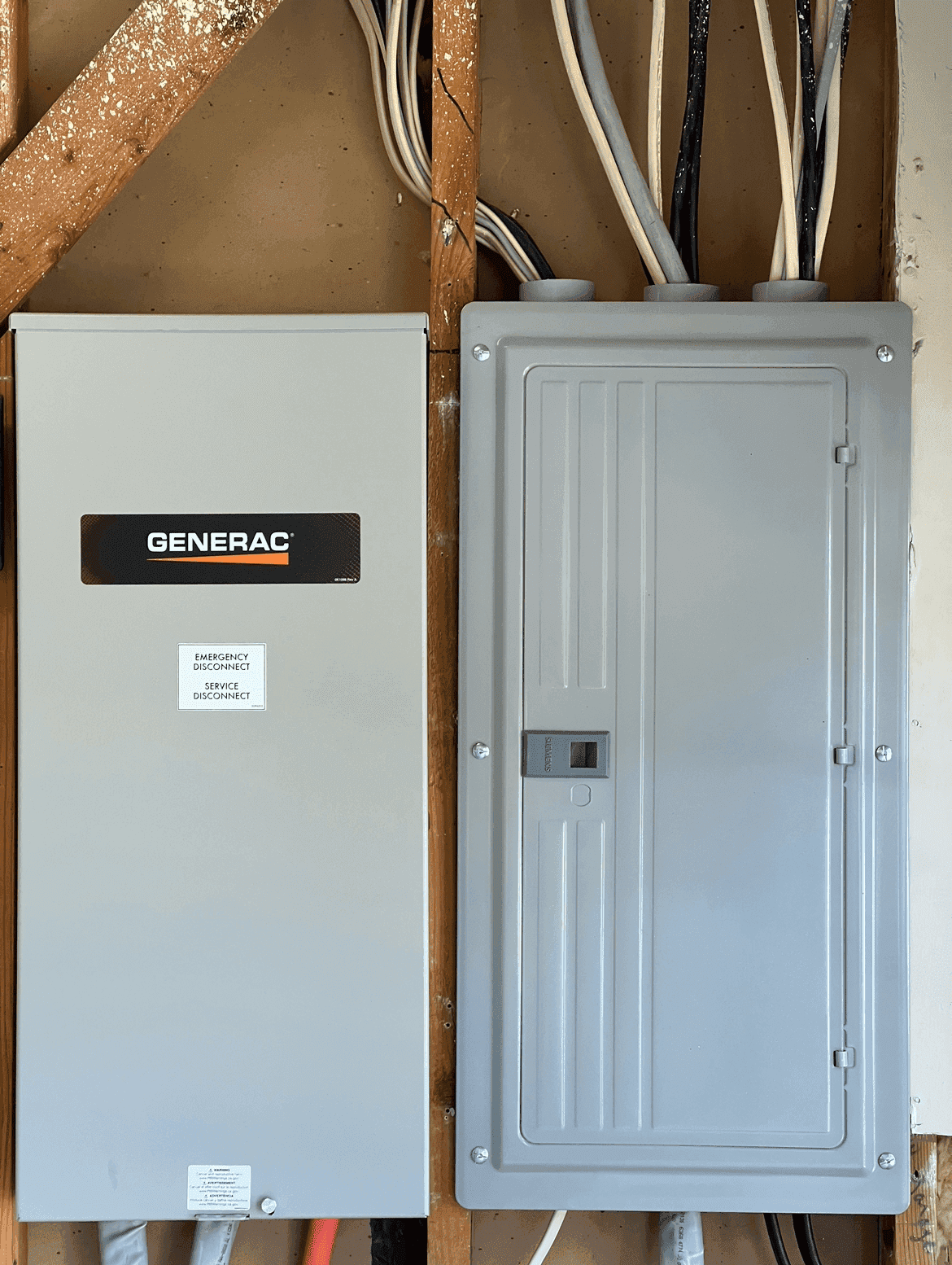
Plug-in power strips don't protect hard-wired equipment like your HVAC, well pump, electric range, oven, garage door opener, or dishwasher. They also do nothing for the dozens of microsurges your home absorbs every week from PSO grid switching and large motor cycling.
A panel-mounted surge protective device (SPD) clamps voltage spikes at the service entrance, before they reach the rest of the home. According to the Electrical Safety Foundation International (ESFI), SPDs are the first line of defense against home electrical surges, and Type 1 devices help protect against nearby lightning strikes. Worth knowing: no surge device can handle a direct lightning strike — even Type 1 hardware is built to absorb induced surges, not a bolt landing on your roof.
If you don't have a panel-level SPD, this is the highest-ROI electrical upgrade in Tulsa. See Whole-Home Surge Protection.
3) Test Your GFCIs (and Make Sure Outdoor Outlets Are Protected)
GFCI (ground-fault circuit interrupter) outlets are required by code in kitchens, bathrooms, garages, basements, crawl spaces, outdoor receptacles, and near pools and tubs. They're also one of the most overlooked items on a homeowner's spring punch list.
What to do:
- Press TEST on each GFCI outlet — the RESET button should pop out and power should cut.
- Press RESET to restore power.
- If a GFCI won't trip, won't reset, or feels warm, replace it (or have us replace it).
- All exterior outlets should be GFCI-protected and inside a weatherproof in-use cover, not a flat flip-up cover. The in-use cover keeps the outlet sealed even when something is plugged in.
If your home is older than the early 2000s, it's worth verifying that every required location actually has a GFCI. We see a lot of Tulsa homes — especially ones built before 1996 — with bathrooms or garages still on standard outlets. That's an easy fix; it's also the kind of fix that matters most when wind-blown rain finds an outdoor outlet.
4) Test the Sump Pump and Battery Backup
If you have a basement, a finished crawl, or any low-lying drainage that depends on a sump pump, test it before storm season. Pour a bucket of water into the sump pit and watch the pump kick on, run, and shut off cleanly.
Two upgrades worth considering before a wet Tulsa spring:
- A battery-backup sump pump that runs even when PSO is out.
- A whole-home generator sized to keep the sump and HVAC online during a multi-hour outage.
A dead sump pump during a heavy spring storm is one of the most common, most expensive flooding scenarios we see. See Generator Installation and Wiring Repair if your sump circuit is old or unreliable.
5) Visually Inspect the Service Entrance — From the Ground
You don't need a ladder for this. Stand back and look up at:
- The weatherhead (the curved fitting where overhead lines enter the conduit). It should be tight to the mast and angled down so water can't run into the conduit.
- The mast (the metal pipe carrying conductors down to the meter). It should be plumb and securely attached to the wall or roof.
- The meter and meter base. No scorching, no rust streaks, no cracked enclosure, no daylight visible inside.
- The exterior conduit running to the panel. No cracks, no detached straps, no exposed wires.
Anything that looks bent, pulled away from the house, scorched, or full of pests is a stop-and-call situation. The mast and weatherhead are technically the homeowner's responsibility past the point of attachment, even though PSO connects to them — and damage there is one of the most common reasons a Tulsa home loses power while neighbors keep theirs.
6) Inspect the Panel — Without Opening It
Open the door to your breaker panel (the outer cover, not the dead front behind it). Look for:
- Rust streaks down the inside of the door, which suggest water intrusion.
- Discolored or scorched breaker faces.
- Breakers stuck in the middle position (not fully ON or OFF).
- A panel directory that's still legible. If yours isn't, fix it before storm season — you'll thank yourself when you're trying to find the right breaker in a hurry.
- A faint hum from a 200A main is normal. A loud buzz, crackle, or burning smell is not.
Don't open the dead front. Don't pull breakers. Anything beyond what's listed above is a job for a Panel Upgrade specialist.
7) Plan Your Generator — Now, Not at 2 a.m.
Tulsa generator demand spikes after every major outage, and that's the worst time to make a thoughtful decision. Before spring storms hit, decide which of these you actually want:
- Portable generator with a manual transfer switch — covers a few essential circuits (fridge, sump, a window unit, a few lights).
- Standby generator wired to an automatic transfer switch — runs the whole panel or selected circuits, kicks on within seconds of an outage, fueled by natural gas or propane.
- Battery backup (whole-home or partial) — increasingly popular, especially when paired with future solar.
The right choice depends on your loads, fuel availability, and how long you're willing to be without power. Get a load calculation early so you have a real plan instead of a guess. See Generator Installation.
8) Trim Trees and Document Your Setup
Before peak season:
- Trim or remove limbs hanging over the service drop, the meter, and the roof.
- Photograph your panel, meter, weatherhead, generator, sump pump, and any major electrical equipment. Date the photos. Store them in the cloud.
You'll be glad you did if you ever file an insurance claim.
9) Sign Up for Alerts and Bookmark the Right Pages
A few minutes spent here saves hours of guessing during a storm:
- NWS Tulsa alerts via phone (Wireless Emergency Alerts are on by default), a NOAA Weather Radio, or an app of your choice.
- PSO Outage Map — bookmark on your phone: psoklahoma.com/outages. The PSO outage hotline is 1-833-776-6884.
- City of Tulsa severe weather information at cityoftulsa.org.
- Ready.gov preparedness checklists at ready.gov/thunderstorms-lightning.
During the Storm: What Not to Do
Once the storm is overhead, the job is simple — *don't make anything worse*.
Don't Touch Anything Plugged Into a Wall
Per Ready.gov, during a thunderstorm you should avoid using anything connected to an electrical outlet — computers, gaming consoles, washers, dryers, ranges. Lightning can travel through a building's wiring and seriously injure anyone in contact with a plugged-in device.
Don't Use Plumbing
Same idea, different path: lightning can travel through a building's plumbing. Skip the shower, bath, and dishes until the storm has fully passed.
Stay Sheltered Until 30 Minutes After the Last Thunder
This is the standard NWS guidance — it's the rule outdoor sports follow for a reason. If you can hear thunder, you're close enough to be struck.
Don't Run Generators Indoors or in a Garage
Carbon monoxide from portable generators kills people every spring storm season. The U.S. Consumer Product Safety Commission (CPSC) recommends operating portable generators outside only, at least 20 feet from the home, with the exhaust pointed away from windows, doors, and vents. Never on a porch. Never under a carport. Never in a garage, even with the door open. Don't refuel a hot generator.
If you're powering 240-volt loads (well pump, central AC, full panel), the right answer is a professionally installed transfer switch or a permanently installed standby generator. See Generator Installation.
Don't Try to Inspect Outdoor Equipment
Wet conditions, wind, hail, falling branches, and possibly downed lines make this a stay-inside-and-look-out-the-window situation. Whatever damage is happening will still be there tomorrow.
Don't Reset a Tripped Breaker More Than Once
A breaker that trips once and resets cleanly is doing its job. A breaker that trips immediately, trips repeatedly, or won't reset at all is telling you there's a downstream problem — a short, ground fault, damaged appliance, or damaged wire. Reset once, and if it trips again, leave it off and call a licensed electrician.
After the Storm: Your Post-Storm Electrical Inspection Checklist
This is where most of the avoidable damage gets done — and the most common cause is rushing.
1) Walk the Property Carefully (At a Distance)
Before touching anything, walk the perimeter and look for:
- Branches on overhead lines or your service drop
- Standing water near outdoor outlets, the AC condenser, the meter, or generator
- A tilted or dislodged meter or mast
- Damaged outdoor lighting or hot tub equipment
- Visible scorch marks anywhere outside
If you see anything in contact with a power line — a fence, a tree, a vehicle — stay back and call 911.
2) Check for Downed Power Lines
OSHA's general guidance is to treat every downed line as energized. For homeowners, that means:
- Stay at least 35 feet away.
- Keep children and pets back.
- Don't touch a line, anything in contact with a line, or step into nearby standing water.
- Call 911 first, then PSO.
Other lines — cable, internet, phone — can become energized when they fall across a power line, so don't try to sort out which is which.
3) Inspect the Weatherhead, Mast, and Meter
From the ground, check whether anything has changed since your pre-season inspection:
- Is the mast bent or pulled away from the house?
- Is the meter base scorched, cracked, or hanging loose?
- Is the weatherhead intact, or did wind/branches damage it?
- Is conduit cracked or pulled apart?
Damage here is a homeowner responsibility past the point of attachment, and PSO won't reconnect service until it's repaired. We handle weatherhead, mast, and meter base repair as part of our Electrical Repair and Wiring Repair services.
4) Look at the Panel
Open the panel door (not the dead front behind it) and check for:
- Tripped breakers. Reset each one once. If it trips again, leave it off.
- Burning or fish-like smell. Stop. Call an electrician.
- Buzzing, crackling, or hissing. Stop. Call an electrician.
- Heat or discoloration. Stop. Call an electrician.
- Water on the inside of the door. Stop. Call an electrician.
A buzzing or scorched panel can be a precursor to an electrical fire and is the most common reason for a same-day Tulsa service call after a storm. A Panel Upgrade is often the right answer for older or damaged equipment.
5) Test Outlets, GFCIs, and Lighting Circuits
Walk the house with a phone charger or a basic outlet tester. You're looking for:
- Outlets that don't work
- GFCIs that need to be reset
- Switches that buzz, feel warm, or smell like plastic
- Flickering or dim lights, especially on the same circuit
- Appliances that won't power on, run hot, or sound different than usual
Single dead outlets are sometimes a tripped GFCI somewhere upstream — push RESET on every GFCI in the house. Persistent flicker, warm switches, or dead circuits after that are surge or wiring damage and need a licensed electrician.
6) Check the Sump Pump
Listen for it cycling. Pour a test bucket if you're not sure. If the pit is filling with no pump activity — *especially during a heavy rain event* — get on the phone with an electrician immediately. We'll prioritize the call.
7) Watch for Surge Damage Symptoms
Surge damage isn't always obvious. Common signs over the days after a storm:
- HVAC blower runs but the compressor doesn't kick on
- Garage door opener acts erratically
- Smart home devices, thermostats, or doorbells offline
- LED bulbs flickering or buzzing
- Microwaves, ranges, or laundry equipment with display issues
- Wi-Fi router or modem unresponsive
If you see two or more of these, you likely took a surge hit. A licensed electrician can confirm with circuit testing and (if needed) thermal imaging. This is also a good time to add a panel-level SPD if you haven't yet — see Surge Protection.
8) Document Everything for Insurance
Photograph any damage, save service receipts, and keep a log of what's not working. Carriers move faster when you hand them a clean file.
Tulsa spring storm
electrical checklist.
Before the storm
Pre-storm prep — high-leverage hours.
- Schedule a pre-storm electrical inspection
- Install whole-home surge protection
- Test every GFCI outlet (kitchen, bath, garage, exterior)
- Test the sump pump and battery backup
- Visually inspect weatherhead, mast, meter, panel
- Trim limbs over service drop and roof
- Decide your generator plan now
- Sign up for NWS Tulsa alerts and bookmark the PSO outage map
During the storm
Stay sheltered — don't make it worse.
- Don't touch anything plugged into a wall outlet
- Don't shower, bathe, or wash dishes
- Stay sheltered until 30 minutes after the last thunder
- Don't run generators indoors or in a garage
- Don't try to inspect outdoor equipment
- Reset a tripped breaker once — only once
After the storm
Inspect carefully, then call the right person.
- Stay 35+ feet from any downed line — call 911, then PSO
- Walk the property; look at weatherhead, meter, panel from a distance
- Reset GFCIs; test every outlet
- Check the sump pump
- Watch for surge symptoms over the next several days
- Document everything for insurance
- Buzzing, scorching, burning smell? Stop and call a licensed electrician
Who to Call: PSO, 911, or a Licensed Electrician
A clean rule of thumb you can hand to anyone in the household:
Call 911 if:
- You see a downed, sparking, or arcing power line
- A line is on a vehicle, fence, tree, or your house
- You see smoke or flames inside walls
- Anyone has been shocked or is in contact with electrical equipment
- You suspect carbon monoxide poisoning from a generator
Call PSO (1-833-776-6884) if:
- The whole neighborhood is dark
- Streetlights are off
- You see a downed line or damaged pole from a safe distance
- A tree is on a service line and the line isn't your property
- You need an outage status or estimated restoration time
Call a licensed electrician (M Electric LLC) if:
- Only your house is out
- You have partial power (some rooms work, some don't)
- The panel is buzzing, hot, scorched, or wet
- You smell burning plastic, fish, or ozone near outlets, panel, or appliances
- A breaker won't stay reset
- Outdoor equipment (mast, weatherhead, meter, conduit) is damaged
- You suspect surge damage to wiring or hard-wired equipment
- You want a post-storm safety inspection before re-energizing major systems
If you're unsure, start with us. We'll tell you straight if it's a PSO issue, a 911 issue, or ours to handle.
Local Help — M Electric LLC Serves the Tulsa Area
We're a licensed, insured Tulsa electrician, and we live and work in this weather right alongside you. Spring storm season is when our pre-storm inspections, panel and surge upgrades, and emergency calls all peak — and we prioritize:
- Same-day diagnosis when only one house on the block is out
- Buzzing, hot, or scorched panels
- Damaged service equipment (mast, weatherhead, meter, conduit)
- Sump pump circuits during heavy rain events
- Suspected surge damage and post-storm electrical inspections
Service area: Tulsa and the surrounding metro. See our full Tulsa Service Area page.
Contact M Electric LLC for emergency electrical repair, post-storm troubleshooting, surge protection, panel inspections, and generator consultations.
Frequently asked questions.
When should I get a pre-storm electrical inspection in Tulsa?
+
Late winter to early spring — ideally February through early April — before the busy April/May/June severe weather window. A 60 to 90 minute inspection of the panel, service entrance, GFCIs, and surge protection catches the issues most likely to fail when storms arrive.
Is whole-home surge protection worth it for a Tulsa home?
+
For most homes, yes. Plug-in surge strips do not protect hard-wired equipment like HVAC, well pumps, ranges, or water heaters, and they do not address the steady microsurges from utility switching and motor loads. A panel-level surge protective device clamps spikes at the service entrance and is one of the highest-value electrical upgrades a Tulsa homeowner can make.
What should I unplug before a thunderstorm?
+
Sensitive electronics like TVs, computers, gaming consoles, modems and routers, smart speakers, medical equipment, and anything with a microprocessor. Per Ready.gov, do this before the storm, not during. Once thunder is overhead, avoid touching anything plugged into a wall.
Why is my house the only one without power after the storm?
+
Almost always because something between the utility lines and your panel was damaged — a service drop, weatherhead, mast, meter base, main breaker, or neutral. PSO does not service equipment past the meter. If only your house is out, you need a licensed electrician, not the utility.
How far should a portable generator be from my house?
+
The U.S. Consumer Product Safety Commission recommends placing portable generators at least 20 feet from the home, with the exhaust pointed away from windows, doors, and vents. Never run a generator in a garage, basement, crawl space, or on a porch, even with doors open.
Should I reset a breaker that tripped during the storm?
+
You can reset it once. If it holds and the equipment on that circuit works normally, you are done. If it trips again immediately or will not reset, leave it off — that is the breaker telling you there is a short, ground fault, or damaged wire downstream. Call a licensed electrician.
Can lightning damage my home's wiring even if it does not strike directly?
+
Yes. A nearby strike can induce a surge that travels through power lines, cable, phone, and buried conduit, and the damage often shows up as failed appliances, flickering circuits, dead outlets, or burned-out smart home devices over the following days. A panel-level surge protective device significantly reduces this risk, but no SPD can stop a direct strike — which is what dedicated lightning protection systems are for.
What does a post-storm electrical inspection actually check?
+
A licensed electrician inspects the service entrance (mast, weatherhead, meter, conduit), opens the panel for thermal imaging and visual checks, tests every GFCI and AFCI, walks the home for dead outlets and warm switches, verifies grounding and bonding, and documents any surge or water damage for your insurance carrier.
- PSO Outage Reporting and Map
- National Weather Service — Tulsa Forecast Office
- NWS Tulsa Severe Weather Information
- Ready.gov — Thunderstorms & Lightning
- OSHA — Power Line Safety Standards
- CPSC — Carbon Monoxide Information Center
- ESFI — What Are Surge Protective Devices
- ESFI — Lightning Electrical Safety
- ESFI — Lightning Protection: Preventing a Direct Strike
- City of Tulsa — Severe Weather Safety